
FOR FUNCTION HEALTH MEMBERS
Your Function Health Labs Already Qualify for a Cardiometabolic Risk Assessment
Function Health’s standard panel includes every biomarker we need to run a complete, guideline-based cardiometabolic risk assessment: ApoB, Lp(a), hsCRP, fasting insulin, A1c, standard lipid panel, and metabolic panel. No new blood draw. No lab visit. Get your assessment for $99.
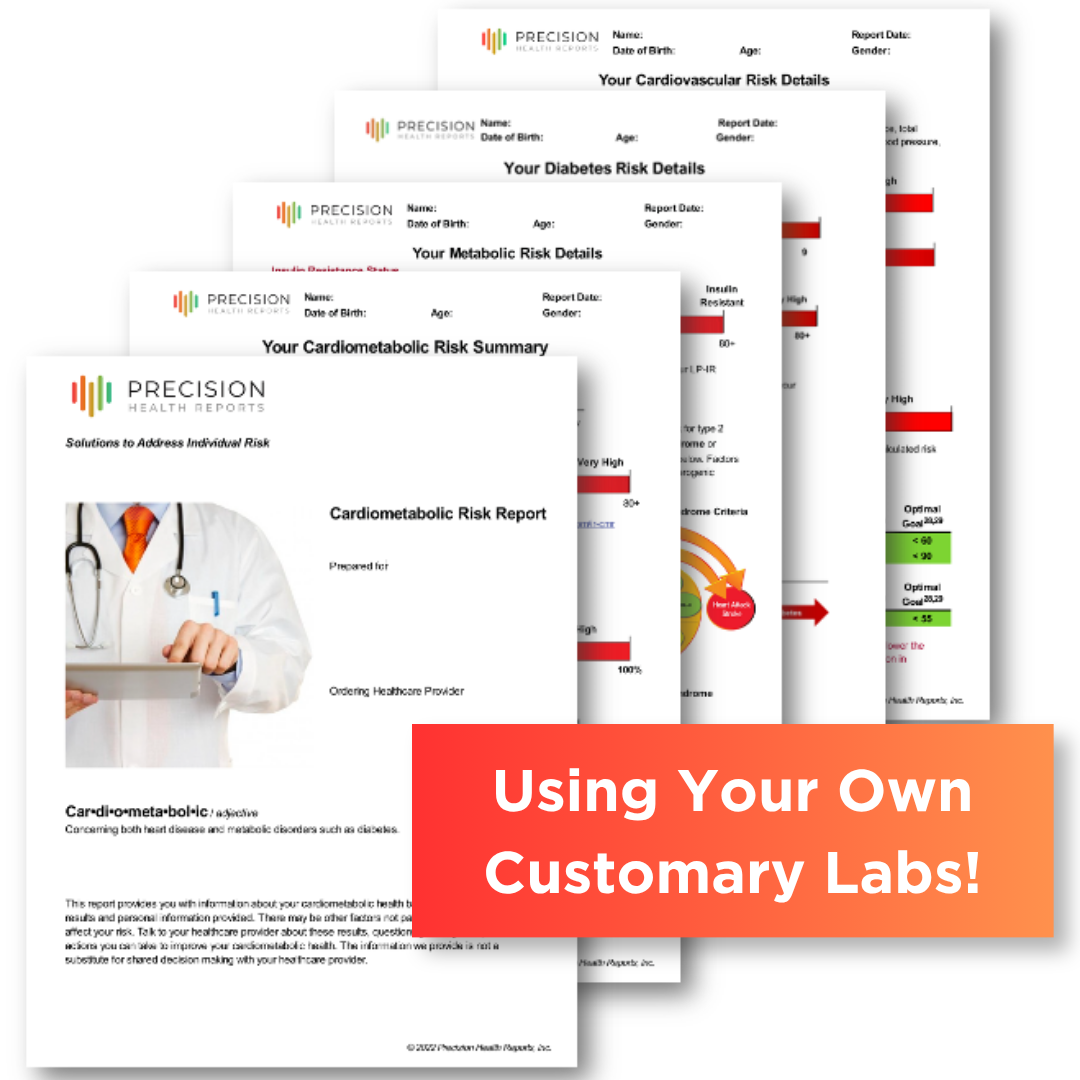
An option to “bring your own labs”—BYOL! Get the same comprehensive and actionable risk assessment report to identify your individual risks for cardiovascular disease, heart attack or stroke, as well as metabolic syndrome and type 2 diabetes using lab results that you already have.
The labs you will need to have:
- Basic lipid (cholesterol, LDL-C, HDL-C, triglycerides)
- ApoB
- Lipoprotein (a) [sometimes called Lp(a)]
- Fasting insulin
- Hemoglobin a1c
- Basic Metabolic Panel (glucose and eGFR needed)
These lab panels are common from various direct to consumer wellness programs like Function Health, Inside Tracker, Superpower (Advanced Package), as well as are often tested by your own physician.
Note: After you complete your Preassessment Questionnaire, we will send you a link to securely upload your own labs to allow our team to complete your Assessment report.
QUALIFYING LABS
Function Health’s standard panel includes ApoB, Lp(a), fasting glucose, fasting insulin, hsCRP, A1c, and a full lipid and metabolic panel. These are the exact biomarkers that power the Cardiometabolic Risk Assessment from Precision Health Reports. If you’ve already drawn your Function Health labs, you’re ready to go!
WHAT PRECISION HEALTH REPORTS ADDS TO YOUR FUNCTION HEALTH RESULTS
Function Health Measures Your Labs. We Tell You What They Mean for Your Heart and Metabolic Health.
Function Health’s panel is genuinely comprehensive, giving you a wide window into your body’s systems. But measuring biomarkers and interpreting cardiometabolic risk are different disciplines. Here is what a Cardiometabolic Risk Assessment adds to the labs you already have:
Guideline-based risk scores: validated heart attack and stroke risk probability, 5-year type 2 diabetes risk, and Metabolic Syndrome Severity Score, derived from the newest 2026 ACC, AHA, and NLA guidelines your cardiologist follows.
Personalized risk-reduction targets: not population reference ranges, but individual thresholds calibrated to your age, sex, ethnicity, and clinical history.
Insulin resistance assessed clinically: HOMA-IR calculated from your fasting glucose and fasting insulin, interpreted against clinical cut-points rather than flagged as in or out of range.
Inflammation in context: your hsCRP interpreted as a cardiometabolic risk factor within your full clinical picture, not an isolated flag.
A clinician-ready report: a downloadable PDF your physician can use directly, with prioritized risk factors and specific intervention targets.
HOW IT WORKS
Three Steps. No New Blood Draw.
Step 1 — Export your Function Health results:
Log in to my.functionhealth.com/documents, click the download button, and save your results as a PDF.
Step 2 — Place your order:
Complete your $99 Cardiometabolic Risk Assessment — Standard Labs order. Shortly after purchase, you’ll receive your welcome email with a link to set up your account and complete your 5-minute clinical history survey. Upload your Function Health PDF at that step.
Step 3 — Receive your assessment:
Within a few business days, you’ll receive your complete cardiometabolic risk assessment: guideline-based risk scores, personalized targets, and a clinician-ready PDF report.
WHAT YOUR ASSESSMENT INCLUDES
Here’s What You’ll Know After Your Assessment
• Your ASCVD risk score: your personalized heart attack and stroke probability, calibrated to your individual profile, starting with PREVENT then further calibrated to your personal risk profile.
• Your 5-year type 2 diabetes risk: adjusted to your gender, ethnicity, and glycemic concordance.
• Your precise Metabolic Syndrome Severity Score: a BMI-adjusted, age-, sex-, and ethnicity-calibrated score that quantifies metabolic syndrome severity beyond a yes/no diagnosis.
• Your insulin resistance status via HOMA-IR: interpreted clinically rather than flagged against a reference range.
• Your atherogenic particle burden: ApoB interpreted against 2026 ACC/NLA guideline thresholds for your personal risk level and targets.
• Your Lp(a) level in clinical context: particularly important if you have a family history of premature heart disease.
• Your inflammation risk: hsCRP contextualized within your full cardiometabolic risk picture, not an isolated flag.
• Personalized risk-reduction targets: 40+ specific, prioritized risk enhancing factors, most modifiable, that you and your physician can act on at your next visit.
CLINICAL CREDIBILITY
Built by a Leading Cardiometabolic Clinician
Precision Health Reports was built on the clinical framework of William Cromwell, MD, FAHA, FNLA — a board-certified lipidologist with 30+ years of specialty practice, 23 peer-reviewed publications including research in The Lancet, and former Chief Medical Officer of LipoScience. His methodology follows clinical guidelines from the ACC, AHA, NLA, ESC, and ADA — the same evidence base your cardiologist uses.
This is not a wellness algorithm. It is the same clinical reasoning that informs the national standards for cardiometabolic care, made available to you directly.
CLINICAL CREDIBILITY
Your Labs Are Ready. Your Assessment Is $99.
Function Health already did the hard part. Use those labs to get a clinical picture of your cardiometabolic risk that reference ranges alone can’t give you.
CTA: ORDER MY OWN ASSESSMENT
FSA/HSA eligible · No subscription required · Results within a few business days
FAQS
Frequently Asked Questions
-
The Cardiometabolic Risk Assessment using Standard Labs requires ApoB, Lp(a), hsCRP, a standard lipid panel (total cholesterol, LDL-C, HDL-C, triglycerides), a basic metabolic panel (which includes fasting glucose), A1c, and fasting insulin. Function Health’s standard panel includes all of these, making most members’ recent results immediately eligible.
-
Results within the past 6 months are generally appropriate for a baseline assessment. If your results are older, or if you’ve made significant lifestyle or medication changes since your draw, we’ll encourage you to get a more current draw. Getting fresher data means more accurate risk targets.
You can order a full Cardiometabolic Risk Assessment with Standard Labs that comes with a fresh complete set of labs for jsut $249.
-
Log in to my.functionhealth.com/documents, click the download button, and save your results as a PDF.
After you complete your Assessment order with us, you will receive a welcome email with a link to set up your account and complete your clinical history survey. You will also recive an email with a secure link to upload your labs. We’re also building a direct Quest integration so future members can authorize us to retrieve results automatically. No PDF upload needed.
-
Yes, meaningfully so. Function Health presents your broad set of lab values against standard reference ranges, flagging results as in or out of range.
Precision Health Reports interprets those same values as a set of interconnected cardiometabolic risk factors, applies the latest 2026 clinical guidelines from the ACC, AHA, and NLA, and produces validated risk scores and personalized intervention targets. It’s the difference between a lab report and a detailed clinical risk assessment about you and your personal risk factors.
-
The assessment is a direct-pay service, but it is FSA and HSA eligible, which reduces the effective cost for many members.
-
Yes. Many people use Function Health for broad health monitoring and Precision Health Reports for deeper, periodic cardiometabolic risk assessments, especially after lifestyle changes, medication adjustments, or to establish a true clinical baseline.