
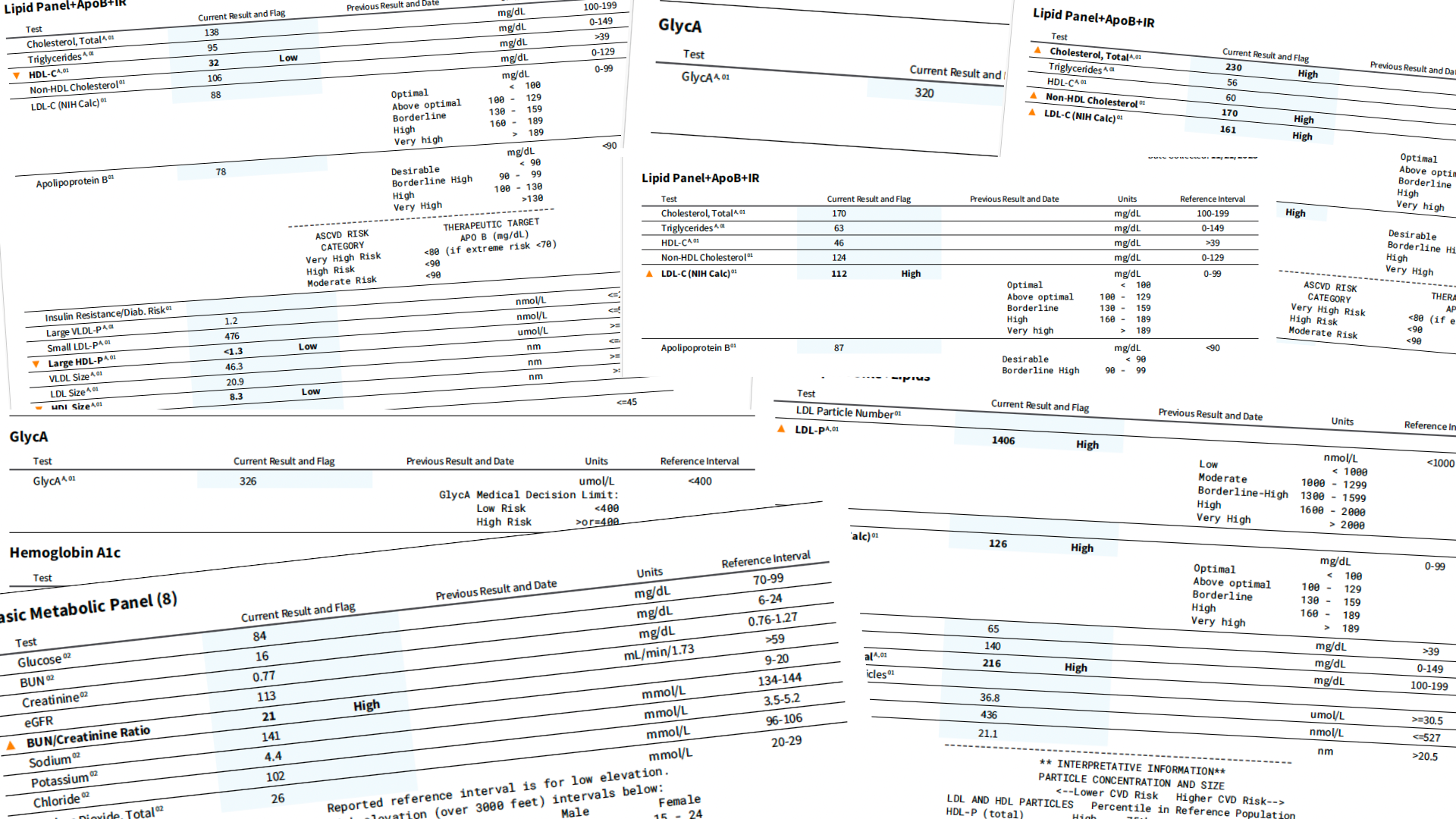
Biomarker Library for Cardiometabolic Risk
Evidence-based explanations of the lab markers that drive atherosclerosis, metabolic syndrome, and type 2 diabetes.
Understanding what to measure is just as important as how to treat. This biomarker library is a clinician and patient-friendly reference for the lab tests most relevant to cardiometabolic risk. Each page explains what the biomarker measures, why it matters for ASCVD events and metabolic disease, how it’s interpreted in guidelines, and how it fits into Precision Health Reports’ Cardiometabolic Risk Assessment. These are important pieces of the puzzle for understanding cardiometabolic disease.
Whether you order labs through Precision Health Reports, a traditional lab panel, or another service, you can use this hub as a neutral reference to guide your understanding of these complex markers.

Lipids & Lipoproteins
Markers that quantify atherogenic particle burden and lipid transport. These biomarkers help determine the true “cholesterol load” driving plaque formation and ASCVD risk.

Inflammation & Vascular Injury
Markers that reflect chronic, low-grade inflammation and vascular injury. They help differentiate stable from unstable disease and refine residual risk beyond lipids alone.

Glucose & Metabolic Markers
Markers that capture insulin resistance, glucose control, and metabolic syndrome. They are critical for understanding risk for type 2 diabetes and cardiometabolic disease progression.
Lipids & Lipoproteins
Apolipoprotein B (ApoB): Primary marker of atherogenic particle number; integrates risk from LDL, VLDL, and remnant particles.
Low-Density Lipoprotein Cholesterol (LDL-C): Traditional “bad cholesterol” measure; still widely used as a treatment target in major guidelines.
LDL Particle Number (LDL-P): Counts the number of LDL particles, which can better reflect risk when LDL-C and ApoB are discordant.
Lipoprotein(a) – Lp(a): Genetically determined, pro-atherogenic and pro-thrombotic lipoprotein associated with premature ASCVD.
High-Density Lipoprotein Cholesterol (HDL-C): Traditionally viewed as “good cholesterol”; more useful as a risk marker than a direct treatment target.
Triglycerides: Reflects triglyceride-rich lipoproteins and remnants; elevated levels are linked with insulin resistance and ASCVD.
Non–HDL Cholesterol: Total cholesterol minus HDL-C; a simple way to estimate all atherogenic cholesterol in routine panels.
Inflammation & Vascular Health
GlycA: NMR-derived marker of chronic inflammation; associated with cardiometabolic risk and residual inflammatory risk.
High-Sensitivity C-Reactive Protein (hs-CRP): Systemic marker of low-grade inflammation; helps refine ASCVD risk beyond traditional risk factors.
Other Inflammation Markers: Overview of additional inflammatory and vascular markers sometimes used to refine risk (e.g., fibrinogen, Lp-PLA₂).
Glucose & Metabolic Markers
LP-IR Score: Lipoprotein Insulin Resistance score derived from NMR lipoprotein profiles; quantifies insulin resistance risk.
HOMA-IR: Learn what HOMA-IR measures, how to calculate it, normal ranges, and how it reflects insulin resistance and cardiometabolic risk.
Fasting Glucose: Core measure for identifying impaired fasting glucose and diabetes; also used in risk prediction models.
Hemoglobin A1c (HbA1c): Reflects average blood glucose over ~3 months; key for diagnosing and monitoring diabetes.
Fasting Insulin: Helps identify hyperinsulinemia and compensatory responses to insulin resistance before glucose becomes abnormal.
Metabolic Syndrome Overview: Explains how waist circumference, blood pressure, triglycerides, HDL-C, and fasting glucose cluster into metabolic syndrome.